
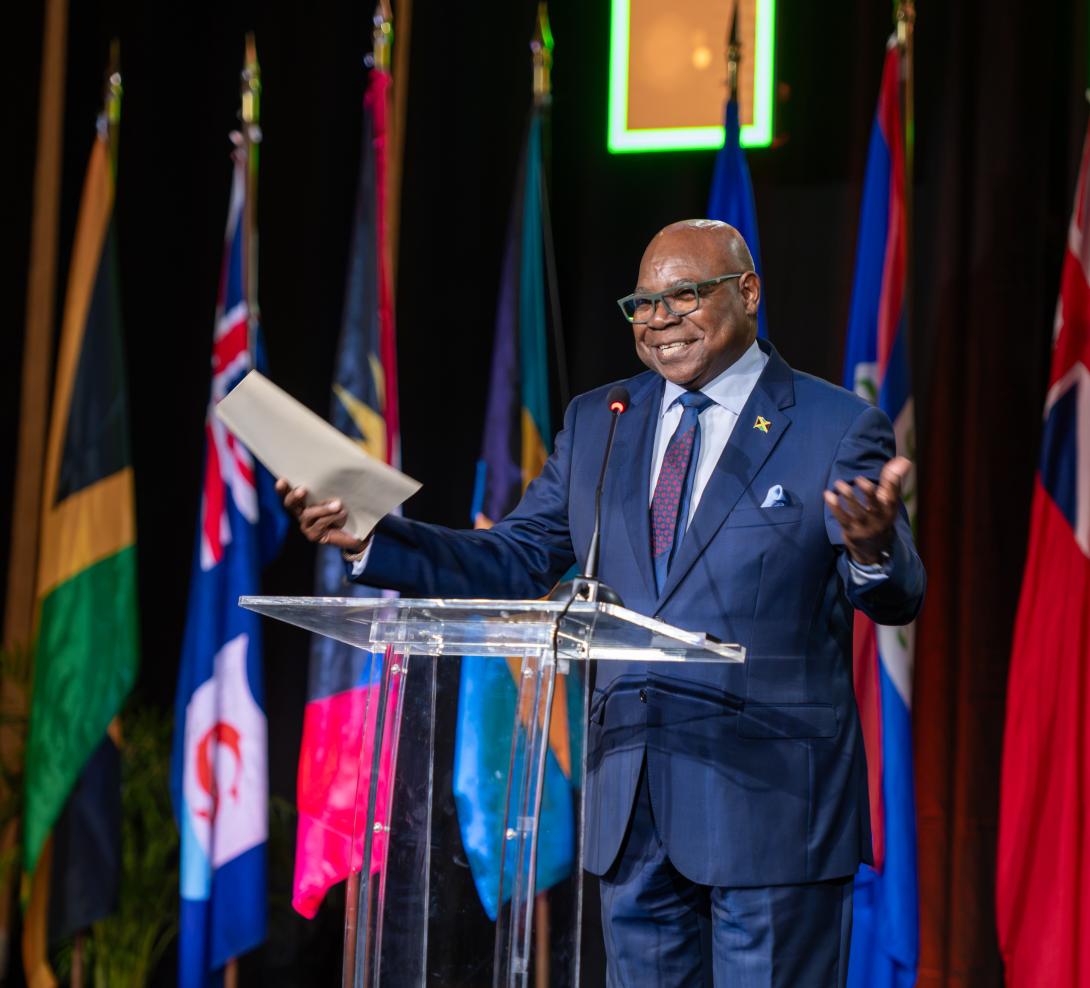
OCHO RIOS, Jamaica; Wednesday, September 2, 2026: Veteran parliamentarian and globally celebrated thought leader, Minister of Tourism, Hon. Edmund Bartlett has underscored that the system of Parliament must become a trusted, fact-based institution in the digital age.
“Let Parliament be the centre of facts and dismiss beliefs,” the former House Leader in Jamaica’s Parliament said as he challenged regional colleagues. He called for the system of Parliament to undergo a fundamental digital transformation while remaining a trusted source of accurate information and democratic accountability.
Addressing the 48th Regional Conference of the Commonwealth Parliamentary Association (CPA) Caribbean, Americas and Atlantic (CAA) Region, at the Moon Palace Jamaica resort, St. Ann earlier this week, Minister Bartlett said technology had fundamentally changed the relationship between citizens and their elected representatives, making it imperative for legislatures to become more open, accessible and resilient.
He told the attendees from 18 countries that with 42 years of service in Gordon House, “I stand before you as someone who entered the Parliament of Jamaica when the primary tools of our trade were paper, microphone, and the force of our conviction.” Contrasting that era with today's digital age where a child from a small rural community can watch parliamentary debates on a mobile phone, question a Member of Parliament online and access legislation before it becomes law.
“From the sugarcane fields to the clouds, that is the journey we are on,” he said, describing the transformation as both profound and unavoidable as delegates meet under the timely theme: “Strengthening Parliament in a Digital Age.”
Mr. Bartlett posited that Parliament should not be viewed merely as a physical building but as an embodiment of the principle that people govern themselves: “And in a digital age, that idea must be renewed, or it will be replaced,” he said.
The veteran parliamentarian identified transparency; efficiency and resilience; and public participation and trust, as key pillars of a modern digital Parliament.
On transparency, he said democracy “dies in darkness but thrives in daylight.” In the digital age, he argued, this means making parliamentary proceedings, voting records and legislation readily accessible online, even as he called for live-streamed proceedings, searchable parliamentary records, open data on voting records and bills published in plain language.
“A digital Parliament must be able to meet during a pandemic, during a hurricane, and during any crisis,” he said. Drawing a parallel with the Caribbean's efforts to strengthen tourism resilience and crisis management, he proposed the creation of a Parliamentary Resilience and Digital Continuity Centre to ensure that democracy could continue functioning during national emergencies.
He also argued that a truly digital Parliament should facilitate digital public consultations, virtual town halls and secure platforms through which young people and members of the diaspora can participate in the legislative process. He said there should also be greater use of video, infographics, Creole and sign language to make parliamentary information understandable to a wider audience. Mr. Bartlett also called for paperless parliamentary committees and artificial-intelligence-assisted research.
However, the objective should not be technology for its own sake he stressed. Adding that “Technology is not the goal. Trust is the goal,” he warned that if citizens do not understand Parliament's work, they cannot fully support it, and if they are excluded from the process, they are less likely to defend democratic institutions.
Minister Bartlett pointed to the growing threat posed by misinformation in the digital environment, noting that: “If Parliament is not present in the digital space, others will fill that space for us.” He therefore urged legislatures to establish themselves as authoritative sources of information, particularly at a time when citizens increasingly turn to social media and digital platforms for news and public commentary.
He said the challenge facing Parliament was ultimately not simply how to adopt new technology, but how to preserve democratic values in a rapidly changing information environment.