
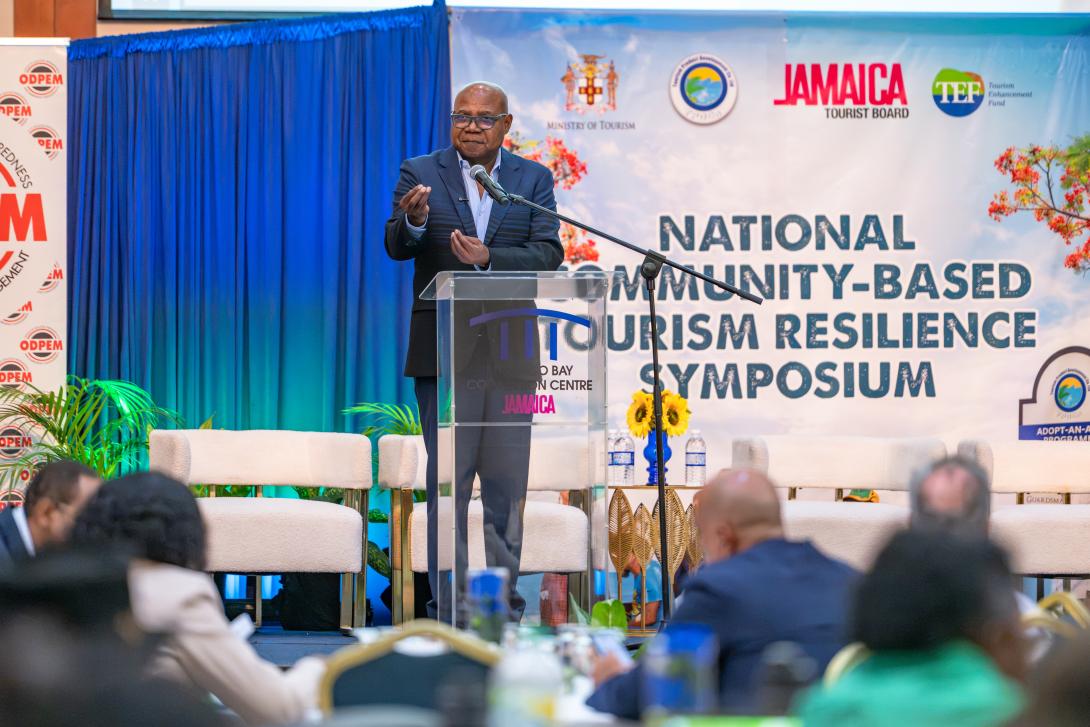
MONTEGO BAY, Jamaica; Friday, July 17, 2026: Community tourism is being positioned to play a leading role in driving Jamaica’s Local First policy direction under the Ministry of Tourism’s new Tourism 3.0 growth strategy but Minister of Tourism, Hon. Edmund Bartlett says there has to be a strategic shift from being a country of samples to one of ample.
“Tourism is nothing but community; it’s everything we do in the community that creates the experiences that give people the desire to return,” he posited while underscoring that the real wealth of tourism is to be found in meeting the supply needs. “We the people of Jamaica must own and in fact direct the supply side of tourism,” Bartlett asserted, noting that, “It is about us building out communities, so we have to build out our farming districts, our fishing villages, our heritage towns, maroon communities, cultural corridors all across the country.”
Minister Bartlett was giving the keynote address at the inaugural National Community-Based Tourism Resilience Symposium at the Montego Bay Convention Centre, yesterday, July 16. The event represented an important step in strengthening the preparedness, adaptability and long-term sustainability of Jamaica’s community tourism sub-sector.
The symposium was conceptualised in response to lessons learnt from previous disruptions to the sector, including pandemics, tropical storms and hurricanes, demonstrating the vulnerability of Community-Based Tourism Enterprises to natural hazards and other disruptions. He therefore stressed the need to build out not only their ability to grow but their ability to withstand disruptions and recover from crises.
The tourism minister stressed that, “Community tourism is not simply tourism-related activities in a community, it is tourism developed with the community, tourism in which residents have a voice, participate in the enterprises and share meaningfully in the benefits.”
Minister Bartlett highlighted that with 20,000 new rooms to be built over the next ten years, the demand that that is going to bring for supplies to be provided by our people will be absolutely phenomenal.
In the same breath, he called on our farmers, agro-processors, pharmaceutical and nutraceutical providers and all the other suppliers of the industry to step up and produce more. “Don’t worry about the things you can’t do, focus on the things you can do and do them well, and let us move from our position as a nation of samples into now a nation of ample.”
He implored suppliers to consider the demand that having 10 million visitors will generate, noting that, “it is on your shoulders that the responsibility to build out the supply side to satisfy the demand of those numbers is going to rest.”
With discussions now underway regarding a new cruise tourism programme that will demand more cultural outputs and special experiences, Minister Bartlett underscored that, “it is going to ask of us some big calls in terms of quality, reliability and sustainability (and) to manage well the process, and most importantly the level of resilience to respond to the different shocks that nature provides.”
Senior Director of Tourism Policy and Monitoring in the Ministry of Tourism, Osbourne Chin said the symposium directly supported the Ministry’s Disaster Risk Management Framework for the Tourism Sector and advanced the priorities of the Revised National Community Tourism Policy and Strategy, which places disaster preparedness, climate resilience and sustainable community development at the centre of the future of community tourism.
He further noted that the Ministry is currently revising the National Community Tourism Policy and Strategy with a team of consultants from Arbor West, which has been engaged and were part of the symposium interacting with participants and stakeholders as part of the finalisation of the Policy.
As a tangible support to the development of community tourism, the Tourism Enhancement Fund (TEF) Resilience/Climate-smart Initiative provided financing assistance to 50 Community-based Tourism Enterprises that were adversely affected by last year’s hurricane.