
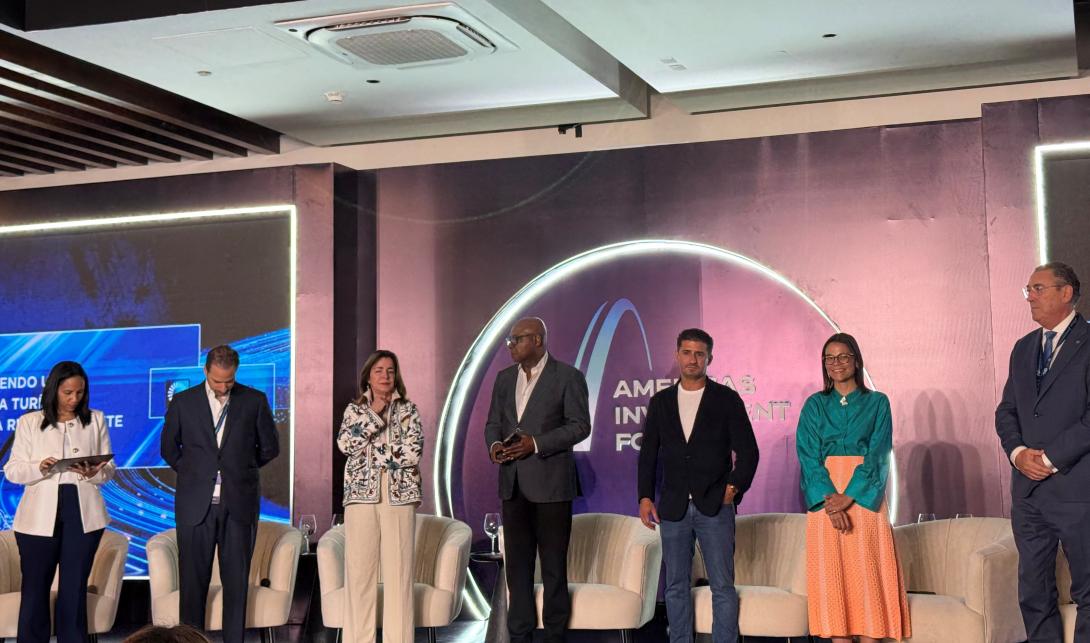
Santo Domingo, Dominican Republic; Thursday, July 2, 2026: “The future of tourism will be defined not by the number of visitors destinations attract, but by the value tourism creates for their people,” Jamaica’s Minister of Tourism, Hon. Edmund Bartlett, declared today as he unveiled Jamaica’s Tourism 3.0 Framework at the Americas Investment Forum 2026.
Speaking during the leadership panel on “Building a Regionally Integrated Tourism Strategy,” Minister Bartlett said the global tourism industry is entering a new competitive era where destinations succeed by combining resilience, innovation, skilled people, seamless visitor experiences and strong governance to create sustainable economic value.
“Jamaica’s Tourism 3.0 Framework recognises that the future of tourism is not simply about growing visitor arrivals, but about growing the value tourism creates for workers, businesses, communities and the wider economy,” Bartlett said. “The destinations that will lead tomorrow are those that invest not only in hotels, but in people, partnerships, productivity, resilience and trust,” he added.
Jamaica’s Tourism 3.0 Framework represents the country’s next-generation tourism development model, shifting the focus from measuring success primarily through arrivals and earnings to maximising tourism’s contribution to productivity, resilience, local ownership and national prosperity.
Bartlett noted that Jamaica’s Tourism 3.0 Framework did not emerge in isolation. Rather, it is the next phase of a decade-long policy agenda that has systematically strengthened the country’s tourism ecosystem and positioned Jamaica among the region’s most competitive destinations.
That foundation, he explained, rests on five long-term policy priorities that have steadily enhanced Jamaica’s competitiveness since 2016: investing in human capital through the Jamaica Centre for Tourism Innovation (JCTI), HEART partnerships and the Tourism Workers Pension Scheme; maintaining a sustainable policy framework that continuously reinvests in destination development, product innovation and community enhancement; modernising infrastructure and visitor experiences; expanding air connectivity and travel facilitation; and embedding destination assurance and resilience across the tourism ecosystem.
According to Bartlett, these investments have done far more than strengthen tourism—they have strengthened Jamaica’s overall investment proposition. “Those are not simply tourism policies. They are investment policies because they reduce risk, improve productivity and strengthen confidence,” Bartlett said.
Building on this foundation, Bartlett outlined that Jamaica’s Tourism 3.0 Framework shifts the conversation from managing tourism growth to maximising tourism’s value.
“Competitiveness today is no longer determined by what a destination has,” he said. “It is determined by what a destination enables. Luxury travellers increasingly choose destinations that deliver authenticity, seamless experiences and confidence. Those outcomes are created through sound public policy, strong institutions and continuous investment,” he added.
He emphasised that the framework builds directly on these achievements by increasing tourism’s contribution to national development through stronger local linkages, greater innovation, increased ownership, higher productivity, resilience and wider prosperity.
That evolution, he argued, is equally important for investors. Future tourism investment will increasingly favour destinations that demonstrate institutional stability, resilient infrastructure, skilled workforces and modern governance.
“Investors today are looking beyond beautiful landscapes,” Bartlett said, adding that: “They are investing in destinations that are predictable, resilient, well-managed and capable of delivering long-term sustainable returns.”
Bartlett underscored that the same philosophy extends beyond Jamaica to the wider Caribbean, urging destinations to embrace what he described as “co-petition”—a model in which countries continue to compete through their distinctive experiences while collaborating where scale creates greater value.
“The Caribbean has reached the point where collaboration is no longer optional,” Bartlett said. “I call it co-petition—the ability to compete where our uniqueness creates value while collaborating where our collective strength creates advantage. Our music, culture, gastronomy, heritage and people are what make each destination unique. Those are the experiences we should continue to compete on. But when it comes to air connectivity, visa facilitation, climate resilience, destination assurance, digital innovation, workforce development and investment promotion, we are stronger when we work together,” he expressed.
“Tourism 3.0 is ultimately about moving from a visitor economy to a value economy,” Bartlett concluded. “When tourism creates greater opportunity for workers, stronger businesses, more resilient communities and better lives for our people, then we will know we have truly succeeded. The future does not require the Caribbean to become one destination. It requires us to become one competitive tourism ecosystem—built on co-petition, where we collaborate where scale matters and compete where authenticity matters,” he explained.
He pointed to Jamaica’s leadership in tourism resilience as evidence that national innovation can create regional and global value. The establishment of the Global Tourism Resilience and Crisis Management Centre (GTRCMC), together with Jamaica’s internationally recognised groundbreaking COVID-19 Resilient Corridors, has positioned the country as a global thought leader in tourism resilience while strengthening the wider Caribbean’s competitiveness.
The leadership panel formed part of the Americas Investment Forum 2026, bringing together senior government officials, international investors, tourism executives and UN Tourism leadership to examine strategies for strengthening tourism investment, sustainability and regional integration.