
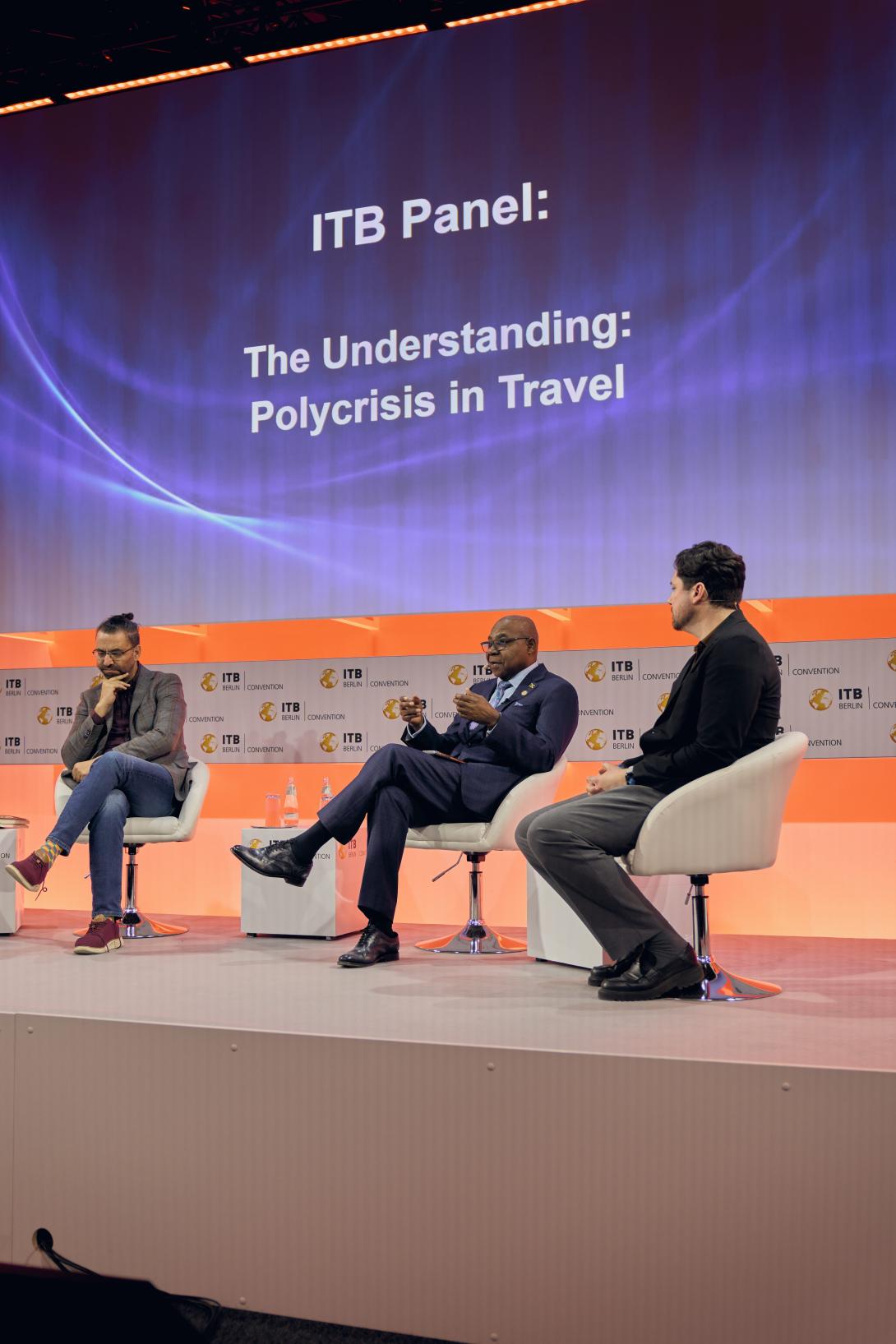
KINGSTON, Jamaica; Thursday, March 5, 2026: Minister of Tourism, Hon. Edmund Bartlett, delivered a wide-ranging address recently during a high-level panel discussion on poly-crisis and its impact on the global tourism industry, underscoring both the profound vulnerabilities and remarkable resilience of tourism as the world’s most important economic activity.
Speaking before an international audience of tourism leaders, policymakers, and industry stakeholders at ITB Berlin, the Minister emphasised that tourism operates at the intersection of geophysical, climatic, maritime, and political forces — making it uniquely susceptible to global disruption, yet equally capable of recovery and growth.
“We are the most vulnerable of all economic activities on planet Earth,” the Minister stated, “but we also have the capacity to respond, to recover, to bounce forward — not bounce back — and to thrive thereafter.”
The Minister noted that tourism has evolved from a largely social activity into a powerful economic force, now embracing thousands of communities and scores of countries worldwide. This transformation has made the sector’s exposure to poly-crisis both more consequential and more urgent to address from a public policy standpoint.
Addressing the role of tourism in global diplomacy, the Minister described the industry as a fundamental connector of peoples, ideas, lifestyles, and ideologies. “Peace is not merely the absence of conflict, but the presence of connection,” the Minister said, stressing that tourism uniquely enables such connectivity across borders and cultures.
The Minister also acknowledged the complex role of religion and politics in either fostering understanding or deepening divisions, calling for collaboration grounded in mutuality and shared human experience. “Our politics can bring us together, and yet our divisions may say no — this is a major crisis we must face,” the Minister observed.
When asked for recommendations to fellow political leaders on building resilience, the Minister placed innovation at the heart of the solution. “Ideas are what drive tourism. Our job as political leaders must be to incentivise ideas, to create the incubator for new ideas, to support new ideas, and ultimately to monetise them,” the Minister said.
The Minister highlighted a flagship national initiative: the establishment of a Tourism Innovation Incubator designed to support young entrepreneurs with bold ideas but limited resources. Through this programme, participants receive mentorship from established industry players, access to seed funding for startups, and the opportunity to test their concepts against real-world market conditions.
“We said: come to us with new thinking on tourism. How do we innovate? How do we use your creativity to drive new experiences?” the Minister explained. “We measure what they bring against established activities, connect them with entrepreneurs and industry drivers, and then support those who want to go further with startup funding,” he added.
The remarks were delivered as part of a panel discussion on poly-crisis, unpredictability, and the future of global tourism, convened to address the mounting convergence of climate, geopolitical, and economic pressures facing the industry.
ITB Berlin (Internationale Tourismus Börse) is the world's leading travel trade show, held annually in Berlin, Germany, since 1966. It acts as a massive B2B platform and networking hub for the global travel industry, showcasing destinations, tour operators, airlines, and hospitality businesses.